In any workplace that handles hazardous chemicals, ensuring proper labeling is not just a best practice—it is a legal requirement with serious implications for worker safety and regulatory compliance. While most safety professionals are familiar with the Globally Harmonized System (GHS) labels that appear on primary containers from manufacturers, the rules for labeling secondary containers are often a source of confusion, inconsistency, and compliance violations. This comprehensive guide clarifies OSHA’s requirements for secondary container labeling, explains the necessary label elements, identifies common mistakes, and provides practical guidance to ensure your facility remains compliant while keeping workers safe.
Understanding Secondary Containers in the Workplace
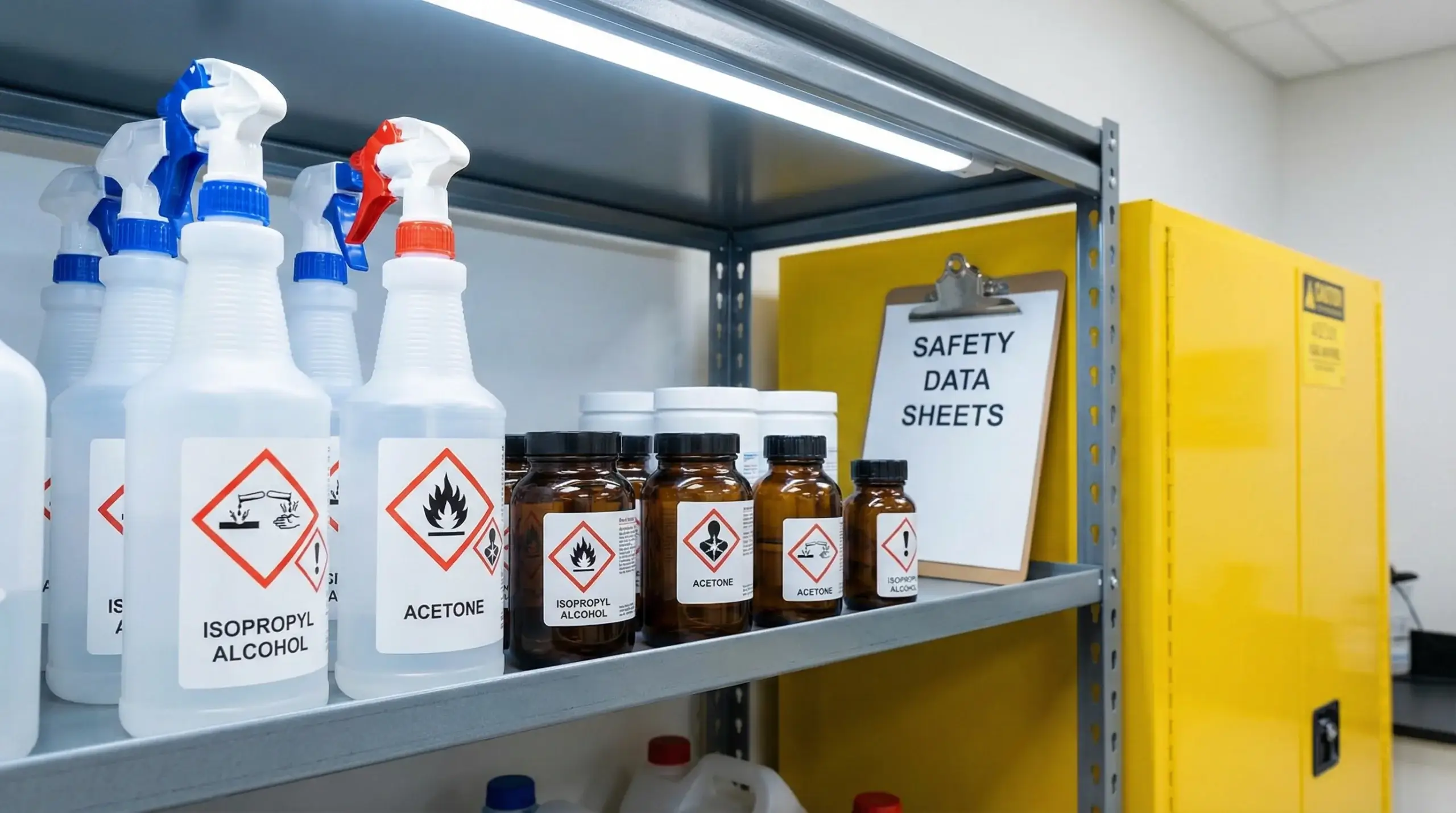
A secondary container is any container into which a hazardous chemical is transferred from its original, primary container. This transfer commonly occurs when workers need smaller quantities of a chemical for specific tasks, when chemicals are diluted or mixed, or when the original container is too large or impractical for the intended use. Secondary containers are ubiquitous in workplaces across virtually every industry and include:
Common Secondary Container Examples:
- Spray bottles used for cleaning solutions
- Squeeze bottles for solvents or lubricants
- Beakers and flasks in laboratory settings
- Buckets and pails for larger quantities
- Drums for bulk storage
- Portable fuel containers
- Small bottles for sample collection
Essentially, if you pour, pump, or otherwise transfer a chemical from the container it came in into another container for use or storage, that second container is a secondary container and must be labeled correctly according to OSHA’s Hazard Communication Standard.
OSHA’s Hazard Communication Standard and Secondary Containers
OSHA’s Hazard Communication Standard (HCS), codified at 29 CFR 1910.1200, is designed to ensure that information about chemical hazards and associated protective measures is transmitted to workers. The standard requires employers to implement a comprehensive hazard communication program that includes container labeling, safety data sheets (SDSs), and employee training.
According to OSHA’s official interpretation, employers must ensure that each container of hazardous chemicals in the workplace is labeled, tagged, or marked with appropriate hazard information. While the full GHS label format with its six specific elements is required for primary containers shipped from manufacturers, OSHA provides some flexibility for workplace (secondary) container labels.
Minimum Requirements for Secondary Container Labels
Under OSHA’s Hazard Communication Standard, a workplace label must include, at a minimum, two essential elements:
- Product Identifier: This is the name or designation used to identify the hazardous chemical. It can be the common name, chemical name, trade name, or code name—as long as it matches the identifier used on the Safety Data Sheet and allows employees to cross-reference for more detailed information.
- General Hazard Information: This can be conveyed through words, pictures, symbols, or a combination thereof that provides at least general information regarding the hazards of the chemical. This information must be sufficient, in conjunction with other available information like Safety Data Sheets, to provide employees with specific information about the physical and health hazards of the chemical.
The key phrase in OSHA’s requirement is “in conjunction with other information immediately available to employees.” This means that secondary container labels work as part of a complete hazard communication system, not in isolation. Employees must have ready access to SDSs that provide detailed hazard information for any chemical identified on a workplace label.
Key Elements for a Compliant and Effective Secondary Label
While OSHA’s minimum requirements allow for simplified workplace labels, best practices suggest including additional information to maximize safety and clarity. The following table outlines recommended label elements:
| Label Element | Description | Required or Recommended |
|---|---|---|
| Product Name/Identifier | The common name, chemical name, or code that matches the SDS | Required |
| Hazard Pictograms | GHS pictograms from the primary container showing hazard types | Recommended |
| Signal Word | “Danger” or “Warning” indicating severity level | Recommended |
| Hazard Statements | Brief descriptions of hazard nature (e.g., “Flammable liquid”) | Recommended |
| Precautionary Statements | Safe handling instructions (e.g., “Keep away from heat”) | Recommended |
| Date Transferred | When the chemical was transferred to the secondary container | Recommended |
| Expiration Date | If applicable, when the chemical should no longer be used | Recommended |
Including these additional elements from the GHS label creates a more robust safety communication system and reduces the likelihood of incidents caused by incomplete hazard awareness.
The Immediate Use Exception: When Labels Are Not Required
There is one important exception to the secondary container labeling rule that is frequently misunderstood. A portable container does not need to be labeled if it meets all of the following criteria for immediate use:
- The container is under the control of and used only by the person who performed the transfer
- The chemical is used entirely within the same work shift during which the transfer occurred
- The container remains within the work area of the employee who transferred the chemical
If any of these conditions is not met, the container must be properly labeled. Specifically, a label is required if:
- The container is left unattended, even briefly
- The container is stored for later use (even later the same day)
- The container is handed off to another person
- The employee leaves the work area with the container
- The chemical will not be completely used during the current shift
This exception is narrow by design. OSHA recognizes that requiring labels for truly immediate, personal use would be impractical, but the exception should not be used as a loophole to avoid labeling responsibilities.
Common Secondary Container Labeling Mistakes
Compliance audits and incident investigations frequently reveal the same labeling mistakes across different facilities and industries. Avoiding these common errors will help ensure your labeling program is compliant and effective:
Using Illegible or Deteriorating Labels: Labels must remain legible throughout the life of the container. Handwritten labels that smear, fade, or become illegible violate the standard. Labels exposed to chemicals, moisture, or abrasion must be replaced when they become difficult to read.
Omitting Hazard Information: Simply writing the product name on a container is not sufficient. The label must include information about the hazards present. A label that says only “Acetone” without any hazard indication does not meet OSHA requirements.
Using Abbreviations, Codes, or Jargon: All employees must be able to understand the label. Using abbreviations, chemical formulas, or facility-specific codes that workers may not recognize defeats the purpose of the label. If codes are used, employees must be trained on their meaning.
Failing to Label Containers at All: This is the most common and most serious violation. Every secondary container of hazardous chemicals must be labeled unless it qualifies for the immediate use exception. “We always know what’s in it” is not an acceptable substitute for proper labeling.
Relying on Container Shape or Color: Assuming that workers will recognize chemicals by the type of container or the color of the liquid is dangerous. Different chemicals may look similar, and assumptions can lead to serious incidents.
Not Updating Labels When Contents Change: If a container is emptied and refilled with a different chemical, the label must be updated to reflect the new contents. Old labels must be removed or completely covered.
Ensuring SDS Accessibility
Because secondary container labels work in conjunction with Safety Data Sheets, ensuring that SDSs are readily accessible is essential to compliance. According to OSHA, SDSs must be “immediately available” to employees in their work area throughout each work shift. This means:
- SDSs cannot be stored in a locked office or supervisor’s desk
- Electronic access is acceptable if employees can access the system without barriers
- Remote work sites must have alternative arrangements for SDS access
- Employees must be trained on how to access and use SDSs
If your secondary container labels rely on employees consulting SDSs for detailed hazard information, those SDSs must be genuinely accessible—not just theoretically available.
Implementing an Effective Secondary Container Labeling Program
Developing a compliant and effective secondary container labeling program involves several key steps:
Step 1: Conduct a Container Inventory. Identify all locations where chemicals are transferred to secondary containers and all types of secondary containers in use throughout your facility.
Step 2: Establish Labeling Standards. Decide on a consistent label format that meets or exceeds OSHA requirements. Consider using pre-printed labels, label templates, or a labeling system that ensures consistency.
Step 3: Provide Appropriate Labeling Materials. Ensure that appropriate labels and marking materials are available wherever secondary containers are filled. This includes durable labels that will withstand the environment and chemicals they may contact.
Step 4: Train All Employees. Training must cover what information is required on labels, how to properly label containers, where to find SDSs, and the importance of compliance. Document all training.
Step 5: Conduct Regular Audits. Periodically inspect your facility to identify unlabeled or improperly labeled containers. Address violations immediately and use findings to improve training and processes.
Your Partner in Chemical Labeling Compliance
Navigating the complexities of GHS and OSHA labeling requirements can be challenging, but compliance is essential for protecting your workers and avoiding costly citations. At Safe Ship Commercial Products, we specialize in providing durable, compliant chemical labeling solutions designed for the demands of industrial environments.
Our experts can help you design and implement a labeling system that meets all regulatory standards, withstands your facility’s environmental conditions, and keeps your workplace safe. From pre-printed GHS labels to custom chemical identification solutions, we have the products and expertise to support your compliance efforts.
For more information about our chemical labeling solutions, please visit our Chemical Labeling service page or contact our team to discuss your specific requirements.

Latest Posts

1D vs 2D Barcodes: Which Format Does Your Operation Actually Need?
February 26, 2026

