A single mislabeled cable can shut down an entire network, and the cost adds up fast. According to ITIC’s 2024 Hourly Cost of Downtime Survey, over 90% of large enterprises report that one hour of downtime costs more than $300,000. Proper cable labels and wire labels prevent these costly mistakes.
Whether you manage a data center, a construction site, or an industrial plant, a structured wire labeling system saves time, reduces errors, and keeps your team safe. This guide covers the TIA-606 standard, the types of cable labels available, and how to build a labeling system that works in any environment.
What Is the TIA-606 Standard for Cable Labeling?
The ANSI/TIA-606 standard is published by the Telecommunications Industry Association. It tells facility managers and installers what to label, how to label it, and what records to keep.
The current version is TIA-606-D, published in October 2021. It covers commercial buildings, industrial plants, data centers, healthcare facilities, and residential properties. While TIA-606 is voluntary, it has become the industry benchmark for professional installations. Many project specifications now require it, and some cable warranties depend on compliant labeling to remain valid.
Core Principles of TIA-606
The standard is built on a few key rules that guide every labeling decision:
- Consistency. Use the same labeling scheme across all locations and buildings. Every technician, whether in-house or an outside contractor, should read and understand labels the same way.
- Identification at both ends. Every cable must carry a label on each end. Each label should identify the termination points at both ends of the cable.
- Legibility. Labels must be machine-printed, not handwritten. This ensures readability across the entire system.
- Durability. Labels must last as long as the component they identify. They should resist moisture, heat, and physical wear at the point of installation.
- Record linkage. Information on every label must match a corresponding record in a database or documentation system.
All labels must also meet the requirements of UL 969 for legibility, defacement resistance, and adhesion. UL 969 is the de facto performance standard for durable safety labels. It is referenced in over 450 UL end-product standards.
TIA-606 Administration Classes
One of the most practical features of TIA-606 is its scalable approach. The standard defines four classes of administration based on the complexity of your facility:
- Class 1 covers a single telecom room within one building. Ideal for small offices.
- Class 2 covers a single building with multiple telecom rooms. Adds identifiers for backbone cabling, bonding, and grounding.
- Class 3 covers a campus with multiple buildings, including inter-building cabling.
- Class 4 covers multiple campuses connected by wide-area networks.
Pick the class that matches your facility. Many organizations start at Class 1 and scale up as infrastructure grows.
Types of Cable and Wire Labels
Choosing the right label type depends on the environment, the cable diameter, and whether you are marking cables before or after termination. Here are the main types used in industrial and commercial settings.
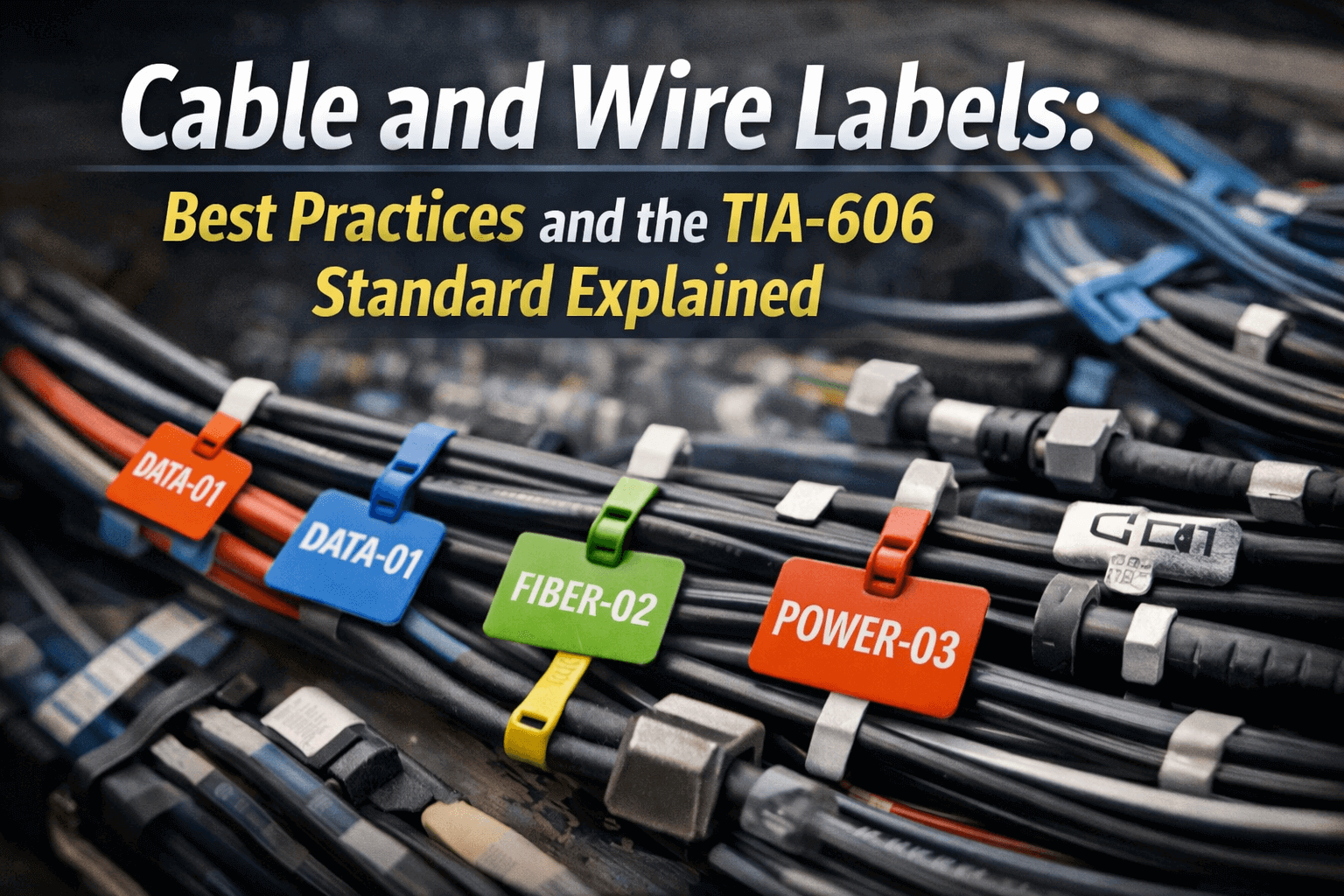
Wrap-Around Cable Labels
Wrap-around labels attach by wrapping completely around the cable. They provide a 360-degree view of the printed information. This makes them easy to read from any angle, even in tight cable bundles. Wrap-around cable labels work well on a wide range of cable diameters and hold up in most indoor environments. They are one of the most common choices for network cable labels in data centers and telecom rooms.
Self-Laminating Wire Labels
Self-laminating labels include a clear protective tail that wraps over the printed area after application. This laminate shield guards against moisture, dirt, chemicals, and abrasion. For facilities that deal with harsh manufacturing environments, self-laminating electrical wire labels offer an added layer of durability that standard wraps cannot match.
Cable Flag Labels
Flag labels stick out like a small flag from the cable instead of wrapping flat around it. They provide more surface area for printed data, which means you can fit multiple lines of text or even a barcode on a thin wire. The trade-off is reduced durability compared to wrap-around or self-laminating options. Cable flags are a smart choice for smaller gauge wires inside locked panels or cabinets where visibility matters most.
Heat-Shrink Sleeves
Heat-shrink markers slide over the cable end and shrink when exposed to heat from a heat gun. They create a tight, permanent fit that resists chemicals, abrasion, and extreme temperatures. Heat-shrink is a top choice for extreme environment labeling where other adhesive labels might peel or degrade over time.
Cable Tags
Cable tags attach to a cable with a loop of wire or a zip tie. They offer generous space for detailed information and are easy to replace without disturbing the cable. Cable tags work best where cables are thick or bundled tightly together.
TIA-606 Color Coding for Cable Identification
The TIA-606 standard recommends a color coding system to identify different connection types. Color coding is not required, but it speeds up troubleshooting and reduces errors.
Here is the recommended color scheme:
- Orange for demarcation points (central office terminations)
- Green for network connections on the customer side
- White for first-level backbone cabling within a building
- Gray for second-level backbone cabling between telecom rooms
- Brown for inter-building backbone cables
- Blue for horizontal cabling at the closet end
- Red for telephone system terminations
You can apply these colors through colored labels, colored bands, or colored cable jackets. The key is to stay consistent across your entire installation.
Best Practices for Implementing a Cable Labeling System
A labeling standard only works if your team follows it. Here are steps to get your wire labeling system right from the start.
Plan Your Naming Convention Before Installation
Define your identifier format before the first cable goes in. TIA-606 uses a hierarchy that can include building, floor, room, rack, panel, and port. For example, “2MK01-35:12” indicates floor 2, marketing room, rack 01, panel position 35, port 12. Document this convention and share it with every installer on the project.
Use a Cable Label Maker for Machine-Printed Labels
Handwritten labels are not TIA-606 compliant. They also fade, smear, and cause confusion. Invest in a reliable wire label maker or cable label maker that produces clean, consistent prints. Thermal transfer printers pair well with durable materials for industrial use. If you need help choosing the right label printer for your business, consider your print volume and operating environment.
Match Label Materials to the Environment
Not every label material works in every setting. Vinyl is a popular choice for general indoor use because it is flexible and durable. Polyester handles higher temperatures and chemical exposure. Polyimide labels stand up to soldering and extreme heat. For outdoor or marine environments, you need materials tested against UV, moisture, and salt spray. Choosing the right industrial label material is one of the most important steps in any labeling project.
Keep Records Updated
A label is only as useful as the documentation behind it. Every cable identifier must link to a record in your system. Update records every time someone makes a move, an add, or a change. This is a core TIA-606 requirement, and it prevents the slow drift toward an unmanageable cable plant. Teams can trace and fix problems faster when labels and records agree. Learn more about how proper labeling reduces downtime in manufacturing and commercial facilities.
Avoid Common Labeling Mistakes
Even experienced installers make errors. Common problems include inconsistent naming, missing labels at one end of a cable, and using labels that do not match the environment. Skipping labels during installation almost always costs more in troubleshooting later. Review the most common mistakes in industrial labeling so your team knows what to watch for.
Why Structured Cable Labeling Matters
A well-labeled cable plant pays for itself. Technicians troubleshoot faster when they can identify every cable at a glance. Upgrades go smoother because the team knows what connects where. Training takes less time when the system is logical and consistent.
For facilities that also rely on barcode labeling solutions for inventory and asset tracking, cable labels fit into a broader identification strategy. Barcoded cable labels let teams scan and pull up records instantly, cutting troubleshooting time even further.
Following the TIA-606 standard and selecting the right cable labels protects your infrastructure investment and keeps operations running.
Get Custom Cable and Wire Labels from SSCPID
Safe Ship Commercial Products Group provides industrial label solutions built for demanding environments. With over 40 years of experience in the metals, chemicals, and construction industries, we design durable labels that perform where standard labels fail.
Whether you need wrap-around cable labels, self-laminating wire labels, heat-shrink markers, or custom cable tags, our team will match the right materials and adhesives to your application. Contact us today to discuss your project and get a free quote.