At the heart of every efficient distribution center, warehouse, or storage facility lies a well-organized labeling system. A warehouse that is poorly labeled is a warehouse prone to errors, lost productivity, frustrated employees, and dissatisfied customers. Whether you are setting up a new facility, expanding an existing operation, or seeking to improve your current processes, implementing an effective warehouse labeling system is one of the highest-impact improvements you can make. This comprehensive guide walks you through the best practices for creating a robust warehouse labeling system, with a particular focus on rack and location labels, to help you streamline operations, improve inventory accuracy, and boost your bottom line.
Why Warehouse Labeling Matters for Operational Efficiency
A systematic approach to labeling is the foundation of efficient warehouse management. The benefits of a well-designed labeling system extend across every aspect of warehouse operations:
Improved Inventory Accuracy: When every location has a unique, scannable label, you can track inventory movements with precision, leading to near-perfect inventory counts. According to industry research, facilities with comprehensive labeling systems typically achieve inventory accuracy rates of 99% or higher, compared to 70-80% for facilities relying on manual or inconsistent methods.
Increased Picking Speed and Accuracy: Clear and logical location labels enable workers to find items quickly and accurately, reducing picking errors and improving order fulfillment rates. Studies show that proper labeling can reduce picking time by 20-30% and cut picking errors by up to 50%.
Faster Put-Away Operations: A standardized labeling system makes it easy for receiving staff to know exactly where to store incoming goods, minimizing put-away time and keeping your receiving dock clear. This is particularly important during peak periods when receiving efficiency directly impacts overall throughput.
Simplified Employee Training: A logical and intuitive labeling system is easy for new employees to learn, reducing training time and getting them productive faster. When location naming follows consistent patterns, workers can often navigate the warehouse effectively within their first few days.
Enhanced Safety: A well-organized warehouse is a safer warehouse. Clear labeling helps prevent accidents by ensuring that items are stored in their correct locations, aisles remain clear, and hazardous materials are properly identified and segregated.
Better Space Utilization: When you can accurately track what is stored where, you can optimize space utilization, identify underused areas, and make informed decisions about layout changes and expansion needs.
Types of Warehouse Labels
There are several types of labels used in a warehouse, each serving a specific purpose in the overall identification system:
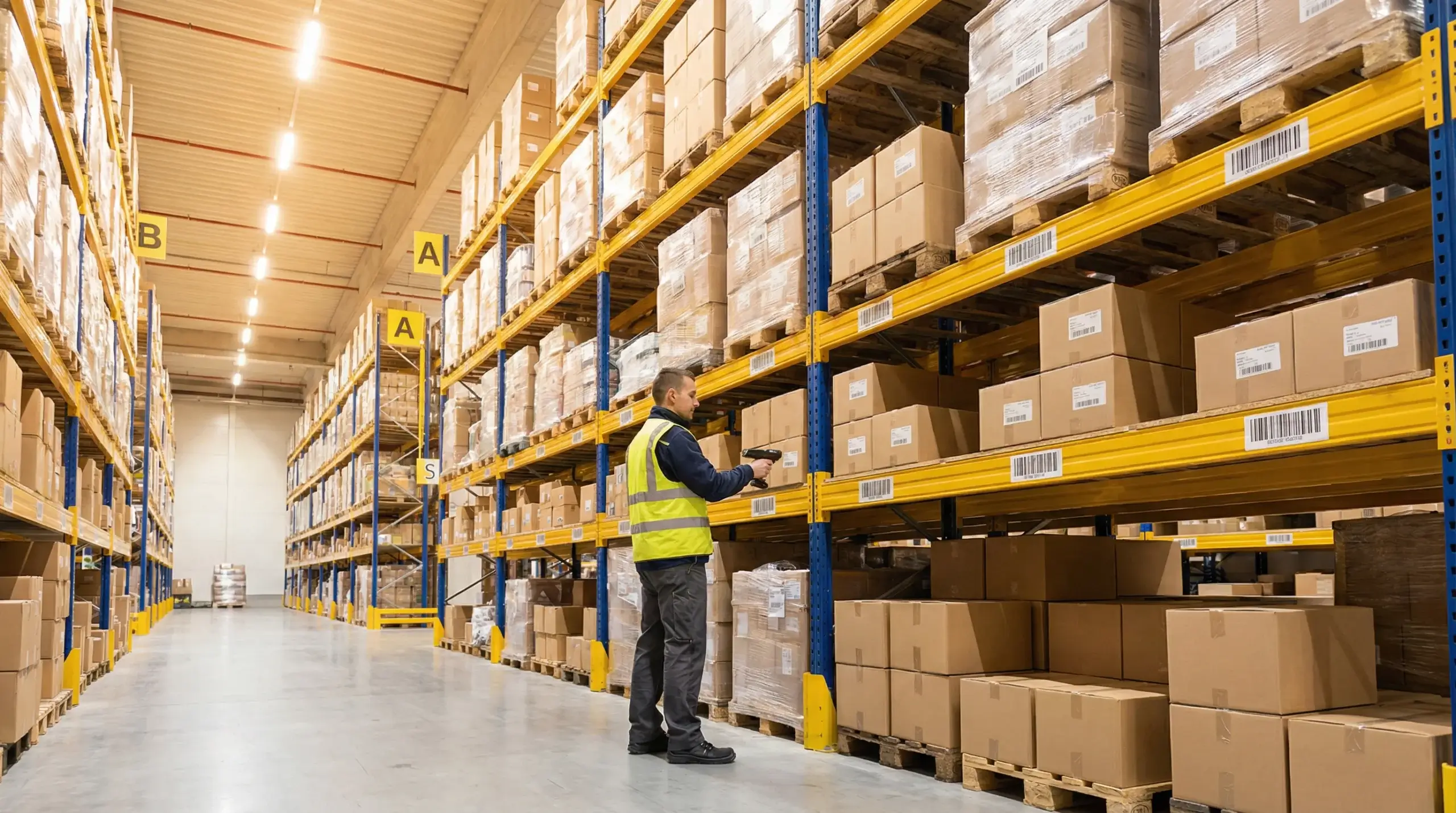
Rack Labels: These are the most common type of warehouse label and are used to identify specific locations on your pallet racking. Rack labels typically include a location code (often with a barcode) and may include additional information such as zone designation or weight capacity. According to Camcode, standard rack labels should be 4×6 inches minimum for reliable scanning at 3-5 feet.
Aisle Labels: Large, highly visible signs at the end of each aisle help orient workers and guide them to the correct area of the warehouse. Aisle markers are typically suspended from the ceiling or mounted on end-of-aisle uprights for maximum visibility.
Floor Labels: In areas where you have bulk floor storage, durable floor labels can be used to mark specific storage lanes or zones. These labels must withstand forklift traffic and heavy abrasion, requiring specialized materials and installation methods.
Bin and Shelf Labels: For smaller items stored in bins or on shelving, smaller labels are used to identify individual bin or shelf locations. These labels follow the same naming conventions as rack labels but are sized appropriately for the smaller storage units.
Long-Range Retro-Reflective Labels: These labels are designed to be scanned from a long distance (up to 45 feet or more), making them ideal for identifying upper rack levels from the ground with a long-range scanner. They use reflective materials that return light to the scanner, enabling reliable reads even in challenging lighting conditions.
Magnetic Labels: For locations that change frequently, magnetic labels offer flexibility. They can be easily moved and repositioned without adhesive residue, making them ideal for dynamic storage areas or seasonal configurations.
Warehouse Numbering Systems and Best Practices
The key to a successful warehouse labeling system is a logical and consistent numbering scheme. According to Mecalux, a well-designed numbering system should be intuitive enough that workers can navigate the warehouse with minimal training. Here are essential best practices to follow:
Keep it Simple and Sequential: The system should be easy to understand and follow. A simple alphanumeric system is often the most effective. Avoid overly complex schemes that require extensive training or reference materials.
Use a Serpentine or Standard Layout: In a serpentine layout, the numbers flow up one side of the aisle and down the other, like a snake. In a standard layout, the numbers on both sides of the aisle increase in the same direction. Each approach has advantages—serpentine minimizes travel distance for sequential picks, while standard layouts are more intuitive for new workers. Choose one method and apply it consistently throughout the facility.
Break Down the Location Name into Logical Components: A good location name typically includes identifiers for multiple levels of specificity. For example, a location name like A01-02-C-03 could represent:
- A01: Aisle 01
- 02: Bay (rack section) 02
- C: Level C (with A being the floor level, B the next level up, etc.)
- 03: Position 03 on the shelf (left to right)
This hierarchical structure allows workers to progressively narrow down the location as they navigate the warehouse.
Use Leading Zeros for Proper Sorting: Using leading zeros (e.g., 01, 02, 03 rather than 1, 2, 3) ensures that your locations sort correctly in your warehouse management system (WMS) and on reports. Without leading zeros, location “10” would sort before location “2” in many systems.
Number Levels from Bottom to Top: Shelves should be numbered from the bottom up, with “A” or “1” being the floor level. This convention is intuitive (ground level is the starting point) and remains consistent even if upper levels are added later.
Plan for Growth: Design your numbering system with future expansion in mind. Leave gaps in your numbering sequence to accommodate additional aisles, bays, or levels without requiring a complete renumbering.
Barcode vs. QR Code for Warehouse Locations
Both barcodes and QR codes can be used for warehouse location labels, and the choice depends on your specific requirements and scanning equipment. Here is a comparison to help guide your decision:
| Feature | 1D Barcode (Linear) | 2D Barcode (QR Code) |
|---|---|---|
| Data Capacity | Low (typically 20-25 characters) | High (up to several thousand characters) |
| Readability When Damaged | Poor (requires intact bars) | Good (built-in error correction) |
| Size Requirements | Requires more horizontal space | More compact for same data |
| Scanning Equipment | Standard laser scanners | Requires imager or camera |
| Read Speed | Very fast | Fast |
| Industry Adoption | Universal | Growing |
For most warehouse location labeling applications, a simple 1D barcode (such as Code 128 or Code 39) is sufficient and remains the most commonly used format. The location code itself is typically short enough that the data capacity of 1D barcodes is adequate. However, QR codes can be useful if you need to encode additional information directly in the label, such as zone descriptions, weight limits, or links to location-specific instructions.
Durable Label Materials for Warehouse Environments
Warehouse environments can be tough on labels. Exposure to dust, moisture, temperature variations, UV light, and physical contact from equipment and handling all contribute to label degradation. Choosing appropriate materials is essential for long-term readability and system reliability:
Polyester Labels: These are a popular choice for rack labeling due to their durability and resistance to moisture, chemicals, and moderate temperature variations. Polyester labels with permanent adhesive provide reliable performance in most warehouse environments.
Retro-Reflective Labels: As mentioned earlier, these are ideal for long-range scanning applications. The reflective material ensures reliable reads even in low-light conditions or at significant distances.
Floor Labels: These are specially designed to withstand forklift traffic, foot traffic, and heavy abrasion. Quality floor labels use multiple protective layers and industrial-strength adhesives to maintain readability under demanding conditions.
Magnetic Labels: These offer flexibility for locations that change frequently. While not as durable as permanent labels, they can be easily repositioned as needs change.
Cold Storage Labels: For refrigerated or frozen environments, specialized labels with cold-temperature adhesives and materials that remain flexible in extreme cold are essential.
Integrating Warehouse Labels with Your WMS
To maximize the value of your labeling system, it must be integrated with your Warehouse Management System (WMS). This integration enables:
Directed Put-Away and Picking: The WMS can direct workers to specific locations for put-away and picking operations, with workers scanning location labels to confirm they are in the correct place.
Real-Time Inventory Tracking: As workers scan location labels during inventory movements, the WMS maintains an accurate, real-time view of inventory across the facility.
Cycle Counting: Location labels facilitate efficient cycle counting programs, allowing workers to scan locations and record counts directly into the WMS.
Performance Analytics: Integration enables detailed reporting on picking accuracy, put-away efficiency, and location utilization, supporting continuous improvement efforts.
Your Partner in Warehouse Organization
Creating and implementing a comprehensive warehouse labeling system is a significant undertaking that requires careful planning, quality materials, and ongoing maintenance. At Safe Ship Commercial Products, we have the expertise and products to help you succeed. From durable rack labels and long-range retro-reflective labels to complete barcoding solutions, we can provide everything you need to get your warehouse organized and running at peak efficiency.
Our team can help you design a labeling system tailored to your facility’s specific layout, workflow, and growth plans. We offer a wide range of label materials to match your environmental conditions and scanning requirements, ensuring reliable performance throughout your operation.
For more information about our warehouse labeling solutions, please visit our Barcode Labeling Solutions and Industrial Labeling Solutions pages, or contact our team to discuss your specific requirements.