Every barcode on your warehouse shelf, shipping pallet, or equipment tag serves one job. It connects a physical item to the data your system needs. But not all barcodes work the same way. Choosing the wrong format can slow scanning, limit the data you track, or force expensive hardware upgrades.
This guide breaks down the differences between 1D and 2D barcodes. You will learn how each type works, where it fits best, and how to match the right format to your operation.
How 1D Barcodes Work
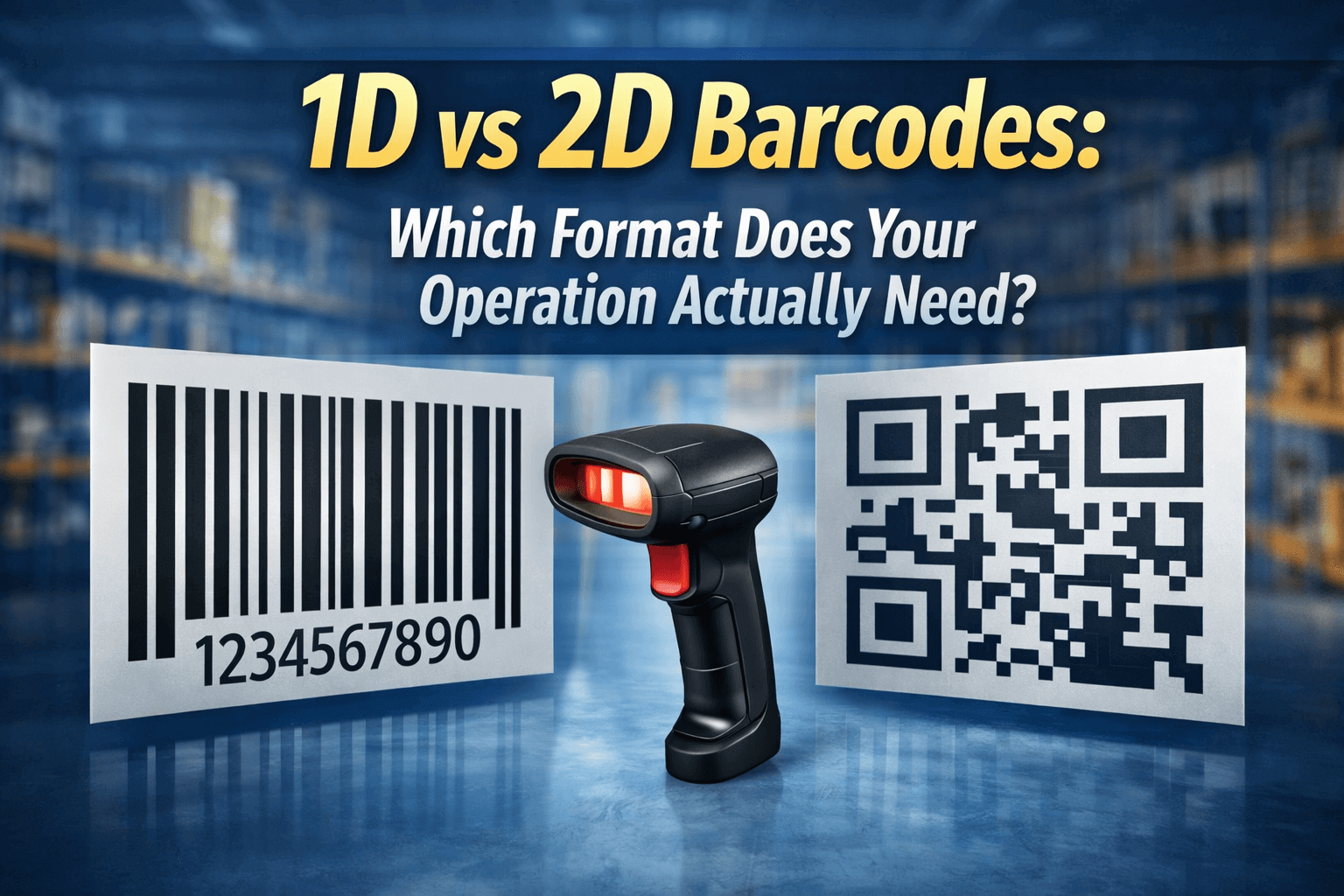
A 1D barcode, also called a linear barcode, stores data in a row of parallel black and white lines. The scanner reads the width of each bar and the spacing between them to decode the information.
Linear barcodes typically hold between 12 and 48 characters, depending on the symbology. They work best for simple identification where the barcode points to a record in a database. The barcode carries a product number or serial code. The database holds the rest.
1D barcodes have been the standard in retail and logistics for decades. They scan fast, cost little to print, and work with nearly every scanner on the market, including basic laser scanners.
Common 1D Barcode Types
UPC (Universal Product Code). The 12-digit barcode found on nearly every retail product in North America. UPC codes identify the manufacturer and the specific product. If you sell consumer goods at retail, UPC is the required format.
EAN (European Article Number). The international equivalent of UPC. EAN-13 uses 13 digits and appears on products sold outside North America. Both UPC and EAN follow GS1 standards for global product identification.
Code 128. A high-density barcode that encodes the full ASCII character set, including letters, numbers, and symbols. Code 128 holds up to about 100 characters in a compact space, which makes it a go-to choice for shipping labels, logistics, and inventory management.
Code 39. An older format used in automotive, manufacturing, and defense. Code 39 encodes letters, numbers, and a few special characters. It takes up more space than Code 128, so it works best on larger labels.
ITF-14 (Interleaved 2 of 5). Designed for printing on corrugated cardboard. ITF-14 barcodes appear on outer cases and cartons in the supply chain. They tolerate the rough surface of cardboard better than other 1D formats.
How 2D Barcodes Work
A 2D barcode stores data in a grid pattern, encoding information both horizontally and vertically. Instead of parallel lines, 2D barcodes use squares, dots, or other shapes arranged in a matrix. This structure holds far more data in a smaller space.
A QR code stores up to 7,089 numeric characters or 4,296 alphanumeric characters. A Data Matrix code holds up to 2,335 alphanumeric characters. Compare that to the 12 digits in a UPC code, and the capacity gap is clear.
2D barcodes also include built-in error correction. If part of the code gets scratched or damaged, the scanner can still read the full data. This makes 2D barcodes a better fit for industrial environments where labels face wear.
The trade-off is hardware. 2D barcodes require camera-based imager scanners. Basic laser scanners cannot read them.
Common 2D Barcode Types
QR Code (Quick Response). The most recognized 2D barcode. QR codes can link to websites, encode contact information, or store product data. Any smartphone camera can read a QR code, which makes it useful for consumer-facing applications and field work.
Data Matrix. A compact 2D barcode preferred in aerospace, electronics, and pharmaceuticals. Data Matrix codes fit into very small spaces, making them ideal for marking individual components and medical devices. The GS1 DataMatrix variant is the standard for pharmaceutical traceability.
PDF417. A stacked barcode that resembles a stretched matrix. PDF417 holds up to about 1,800 characters and appears on driver’s licenses, boarding passes, and shipping documents.
Key Differences Between 1D and 2D Barcodes
Understanding the practical differences helps you make the right choice for your application.
Data capacity. 1D barcodes hold 12 to 100 characters. 2D barcodes hold hundreds to thousands of characters. If your tracking system needs batch numbers, expiration dates, serial numbers, and lot codes all in one scan, 2D is the clear choice.
Physical size. 1D barcodes grow wider as you add data. A Code 128 barcode with 30 characters can stretch several inches. 2D barcodes encode the same data in a much smaller footprint. Data Matrix codes can be just a few millimeters wide.
Scanner requirements. 1D barcodes work with laser scanners and camera-based imagers. 2D barcodes need imagers only. Most modern handheld scanners read both, but legacy laser equipment cannot read 2D codes.
Error correction. 1D barcodes have no built-in error correction. A scratch across the bars can make the code unreadable. 2D barcodes use algorithms that rebuild missing data, so they remain scannable even after partial damage. For labels in harsh manufacturing environments, this durability matters.
Scanning angle. 1D barcodes must be oriented correctly for the scanner to read them. The laser needs a clean horizontal pass across the bars. 2D barcodes can be read from any angle, which speeds up scanning in high-volume operations.
When to Use 1D Barcodes
1D barcodes remain the right choice for many applications. They work well when data requirements are simple and your infrastructure already supports laser scanning.
- Retail point of sale. UPC and EAN barcodes are the global standard for consumer product identification.
- Basic inventory tracking. If your barcode only needs to carry an item number that links to a database, Code 128 or Code 39 does the job.
- Shipping and logistics. GS1-128 barcodes carry product data plus attributes like weight and batch number. ITF-14 works for outer carton identification.
- Budget-conscious rollouts. Laser scanners cost less than imagers. If you are launching a barcode labeling system for the first time, 1D barcodes minimize startup costs.
When to Use 2D Barcodes
2D barcodes make sense when you need more data in less space, when labels face harsh conditions, or when your workflow benefits from smartphone scanning.
- Asset tracking. Encode the asset number, purchase date, and maintenance history in a single Data Matrix code. Learn how barcode systems maximize efficiency in asset management.
- Manufacturing traceability. Track individual parts through every production stage with a small 2D code that holds serial, batch, and lot data.
- Small components. When label space measures only a few millimeters, Data Matrix is the only format that fits. Laser etching can apply 2D codes directly to metal parts and circuit boards.
- Harsh environments. Error correction helps 2D barcodes stay readable after chemical exposure, abrasion, and temperature swings. Pair them with materials built for extreme environment conditions.
- Consumer engagement. QR codes on packaging link customers to product information, setup instructions, or warranty registration.
GS1 Sunrise 2027: The Shift Toward 2D
The barcode landscape is changing. GS1, the organization that manages global barcode standards, has launched the Sunrise 2027 initiative. The goal is for retail POS systems worldwide to accept 2D barcodes alongside traditional 1D codes by 2027. Testing is already underway in dozens of countries.
During the transition, products may carry both a 1D UPC code and a 2D code on the same package. For industrial operations, this shift means 2D barcode infrastructure will become cheaper and more widely supported. If you are planning a new automated barcode system, investing in 2D-capable scanners now prepares your operation for the future.
How to Choose the Right Barcode Format
The best barcode fits your data, your environment, and your equipment. Ask these questions before you decide.
How much data do you need? If a short numeric ID is enough, 1D works fine. If you need multiple data fields in one code, go with 2D.
How much label space is available? Large shipping labels have room for wide 1D barcodes. Small component labels or metal tags need compact 2D codes.
What scanners do you own? Laser-only equipment limits you to 1D. Imager scanners handle both formats. Check your hardware before committing.
What conditions will the label face? Clean indoor settings suit either format. Labels exposed to chemicals, heat, or abrasion benefit from 2D error correction. For guidance on tough-condition materials, read our guide to industrial label materials.
Do industry standards apply? Retail requires UPC or EAN. Pharmaceuticals often require GS1 DataMatrix. Defense may specify Code 39 or Data Matrix. Confirm compliance requirements before selecting a format.
Get the Right Barcode Labels from SSCPID
Safe Ship Commercial Products Group provides barcode labeling solutions for industrial, manufacturing, and logistics operations. With over 40 years of experience, we help you select the right barcode format, label material, and printing method for your specific environment and tracking needs.
Whether you need 1D barcodes for a warehouse rollout or 2D codes for harsh-environment asset tracking, our team builds labels that scan reliably and last. Contact us today to discuss your barcode labeling project.