In any industrial facility, a complex network of pipes transports a wide array of substances—from harmless water to highly hazardous chemicals, flammable gases, and corrosive acids. Without a clear and standardized system for identifying the contents of these pipes, the risk of accidents, injuries, and costly operational errors increases dramatically. This is where pipe labeling standards, particularly those established by the Occupational Safety and Health Administration (OSHA) and the American National Standards Institute (ANSI) in conjunction with the American Society of Mechanical Engineers (ASME), play a crucial role in workplace safety and regulatory compliance.
This comprehensive guide provides an in-depth overview of the ANSI/ASME A13.1 standard, the most widely recognized and implemented pipe identification standard in the United States, and its relationship with OSHA regulations. Whether you operate a manufacturing plant, chemical processing facility, or any industrial environment with piping systems, understanding these standards is essential for maintaining a safe workplace.
The Critical Importance of Standardized Pipe Labeling
Consider a scenario where a maintenance worker needs to shut off a water line during routine maintenance, but mistakenly closes a valve on a pipe carrying a flammable substance. The consequences could be catastrophic—ranging from chemical exposure and fires to explosions and environmental contamination. According to the American National Standards Institute (ANSI), the need for standardized pipe marking became apparent as early as the 1920s when many large companies had developed their own color schemes that lacked universality, creating dangerous situations when workers changed employment from one plant to another.
Standardized pipe labeling provides a universal language that all employees, contractors, and emergency responders can understand, ensuring that everyone is aware of the contents of each pipe and the associated hazards. The benefits extend beyond safety compliance to include improved operational efficiency, reduced downtime during maintenance, and faster emergency response times.
Understanding the ANSI/ASME A13.1 Standard
The ANSI/ASME A13.1 standard provides a comprehensive framework for pipe identification, covering color-coding, label size, text requirements, and placement guidelines. The standard was most recently updated in 2023 (ASME A13.1-2023) to align with the Globally Harmonized System of Classification and Labelling of Chemicals (GHS) and to provide greater clarity on various aspects of pipe marking.
The history of this standard dates back to 1922 when the American Standards Association (the former name of ANSI) organized the Sectional Committee on the Identification of Piping Systems. The initial publication of the scheme for the identification of piping systems came in 1928, and it has been periodically reviewed and revised to remain current with industrial practices and safety requirements.
Key Elements of the ANSI/ASME A13.1 Standard
The standard outlines several key components that must be included on pipe labels to ensure clear and consistent identification across all industrial facilities:
Legend Requirements: The legend is the text on the label that identifies the contents of the pipe (e.g., “Hot Water,” “Natural Gas,” “Sulfuric Acid”). The text should be brief, accurate, and easily understood by all personnel. The 2023 revision expanded the legend section to provide more detailed guidance on content descriptions.
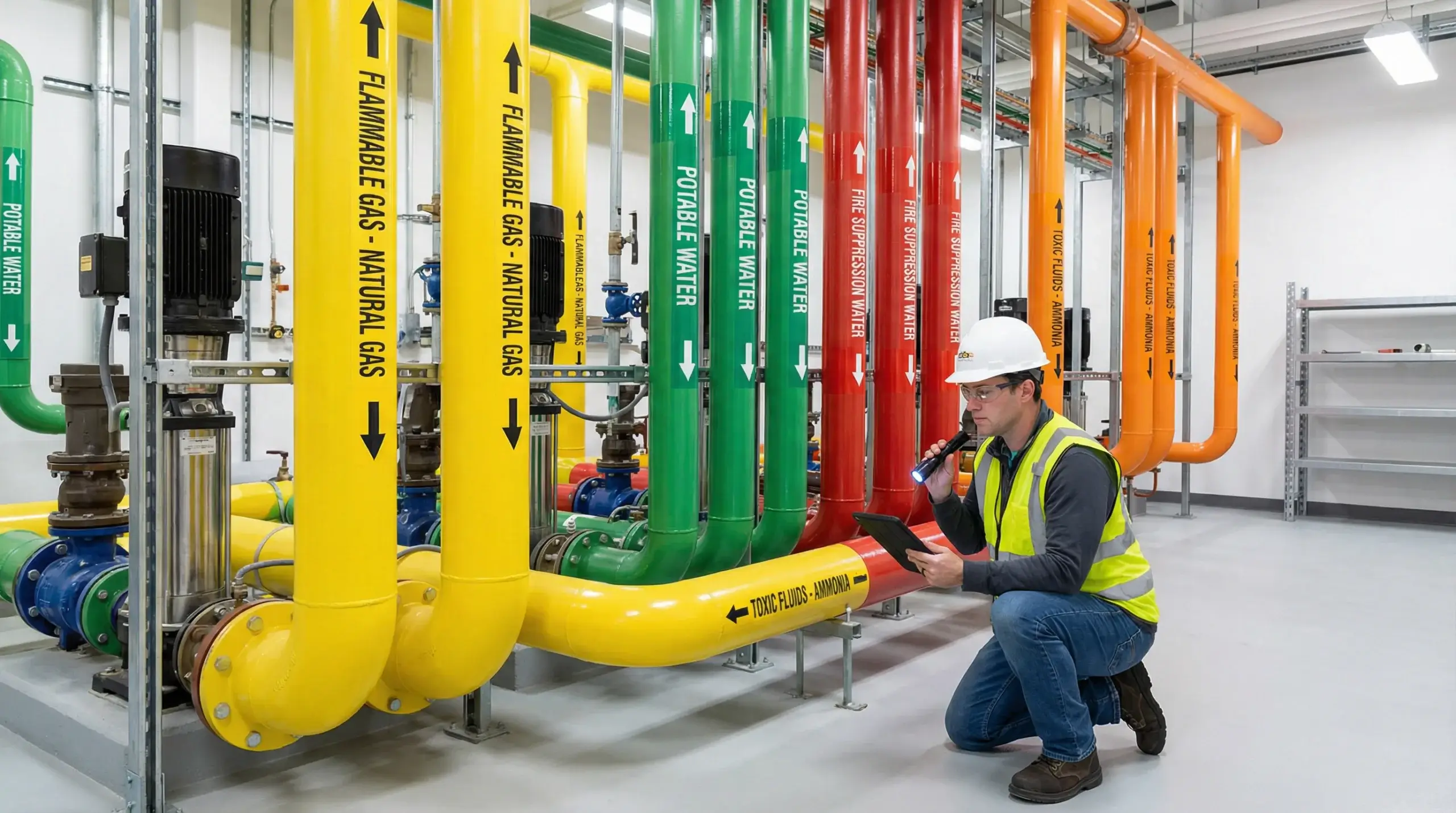
Color Code System: The color of the label provides a quick visual cue about the general hazard category of the pipe’s contents. This allows workers to immediately assess potential risks even before reading the specific contents. The standard specifies six predefined color combinations and allows for four user-defined combinations to accommodate facility-specific needs.
Flow Direction Indicators: Arrows on the label indicate the direction of flow of the substance within the pipe. This is critical for understanding the process flow and for safely isolating sections of the piping system during maintenance or emergency situations.
GHS Pictograms: For pipes containing hazardous chemicals, the appropriate GHS pictograms must be included on the label to communicate specific hazard information. This addition, which was incorporated in the 2015 edition and refined in subsequent versions, ensures alignment with global chemical hazard communication standards.
Label Placement: The 2023 revision renamed the “Visibility” section to “Placement” and expanded it to specify that legends should be applied close to valves or flanges, with provisions for situations where this placement is impractical.
Pipe Marking Color Code Guide
The ANSI/ASME A13.1 standard establishes a color-coding system to quickly identify the general nature of the pipe’s contents. Understanding these colors is essential for all personnel working in industrial environments. The following table summarizes the standard color combinations as specified in the current standard:
| Color Combination (Background/Text) | Hazard Category | Examples of Contents |
|---|---|---|
| Yellow / Black | Flammable and Oxidizing Fluids | Natural gas, hydrogen, oxygen |
| Brown / White | Combustible Fluids | Fuel oil, diesel, lubricants |
| Orange / Black | Toxic and Corrosive Fluids | Acids, caustics, ammonia |
| Red / White | Fire-Quenching Fluids | Fire suppression water, foam |
| Green / White | Other Water | Potable water, cooling water |
| Blue / White | Compressed Air | Plant air, instrument air |
| Purple / White | User Defined | Facility-specific designation |
| White / Black | User Defined | Facility-specific designation |
| Gray / White | User Defined | Facility-specific designation |
| Black / White | User Defined | Facility-specific designation |
It is important to note that while these colors provide a general indication of the hazard category, the specific contents of the pipe should always be confirmed by reading the legend on the label. The user-defined colors allow facilities to establish additional categories specific to their operations while maintaining consistency with the overall standard.
Label Size Requirements
The ANSI/ASME A13.1 standard also specifies minimum label sizes based on the outside diameter of the pipe. Larger pipes require larger labels to ensure visibility from appropriate distances. The following guidelines apply:
| Pipe Outside Diameter | Minimum Label Length | Minimum Letter Height |
|---|---|---|
| 3/4″ to 1-1/4″ | 8″ | 1/2″ |
| 1-1/2″ to 2″ | 8″ | 3/4″ |
| 2-1/2″ to 6″ | 12″ | 1-1/4″ |
| 8″ to 10″ | 24″ | 2-1/2″ |
| Over 10″ | 32″ | 3-1/2″ |
These specifications ensure that pipe labels remain readable from typical working distances and under various lighting conditions found in industrial environments.
OSHA’s Role in Pipe Labeling Compliance
While OSHA does not have its own specific pipe marking standard, it does require employers to inform employees about the hazards of chemicals in the workplace under its Hazard Communication Standard (29 CFR 1910.1200). According to OSHA, employers must ensure that hazardous chemicals are properly identified and that employees have access to information about the hazards they may encounter.
Complying with the ANSI/ASME A13.1 standard is widely considered a best practice for meeting OSHA’s requirements for pipe marking. While OSHA allows employers some flexibility in how they communicate hazard information, implementing a nationally recognized standard like ANSI/ASME A13.1 provides a defensible position in the event of an inspection or incident investigation.
Additionally, many state and local regulations reference the ANSI/ASME A13.1 standard directly, making compliance mandatory in certain jurisdictions. Even where not explicitly required, following the standard demonstrates due diligence in protecting worker safety.
Implementing a Compliant Pipe Labeling Program
Developing and implementing a compliant pipe labeling program involves several key steps that require careful planning and execution:
Step 1: Conduct a Comprehensive Facility Assessment. Begin by identifying all pipes and their contents throughout your facility. This includes not only production areas but also utility systems, HVAC piping, and any other systems that transport fluids or gases. Document the contents, flow direction, and any special considerations for each pipe.
Step 2: Select Appropriate Label Materials. Pipe labels need to be durable enough to withstand the specific environmental conditions of your facility, including exposure to chemicals, extreme temperatures, UV radiation, and physical abrasion. Different areas of your facility may require different label materials. For example, pipes in outdoor areas need UV-resistant materials, while pipes in high-temperature areas require heat-resistant labels.
Step 3: Design Labels According to Standard Requirements. Ensure that all labels include the required elements: legend, color coding, flow direction arrows, and GHS pictograms where applicable. Labels should be sized appropriately for the pipe diameter and positioned according to the standard’s placement guidelines.
Step 4: Establish a Placement Strategy. Labels should be placed at frequent intervals along the pipe, near valves, flanges, and changes in direction, and at wall and floor penetrations. The goal is to ensure that the pipe’s contents can be identified from any point in the system without requiring workers to trace the pipe back to a labeled section.
Step 5: Implement Employee Training. All employees who work with or around the piping systems should be trained on the meaning of the different colors, legends, and symbols used in your pipe labeling program. Training should be documented and refreshed periodically, especially when new employees join or when changes are made to the labeling system.
Step 6: Establish a Maintenance and Inspection Program. Pipe labels can become damaged, faded, or obscured over time. Establish a regular inspection schedule to identify and replace labels that are no longer legible or properly positioned. This is particularly important in harsh environments where label degradation may occur more rapidly.
Special Considerations for Abandoned Piping
The ASME A13.1-2023 standard includes specific provisions for identifying abandoned piping—pipes that are no longer in service but remain in place. The standard recommends a specific color scheme and border for abandoned piping to clearly distinguish it from active systems. This is an important safety consideration, as workers may otherwise assume that abandoned pipes are still active or attempt to use them for new purposes without proper evaluation.
Conclusion
A well-implemented pipe labeling program based on the ANSI/ASME A13.1 standard is an essential component of a safe and efficient workplace. By providing clear and consistent information about the contents of your piping systems, you can significantly reduce the risk of accidents, improve emergency response capabilities, and ensure compliance with OSHA regulations and industry best practices.
At Safe Ship Commercial Products, we understand the critical importance of proper pipe identification in maintaining workplace safety. Our team of experts can help you assess your facility’s needs and implement a comprehensive pipe labeling solution that meets all applicable standards and regulations. We offer a wide range of durable labeling materials designed to withstand the most demanding industrial environments.
For more information on our industrial labeling solutions, including pipe markers, safety labels, and custom identification products, please visit our Labeling and Tagging service page or contact our team to discuss your specific requirements.
Latest Posts

1D vs 2D Barcodes: Which Format Does Your Operation Actually Need?
February 26, 2026

